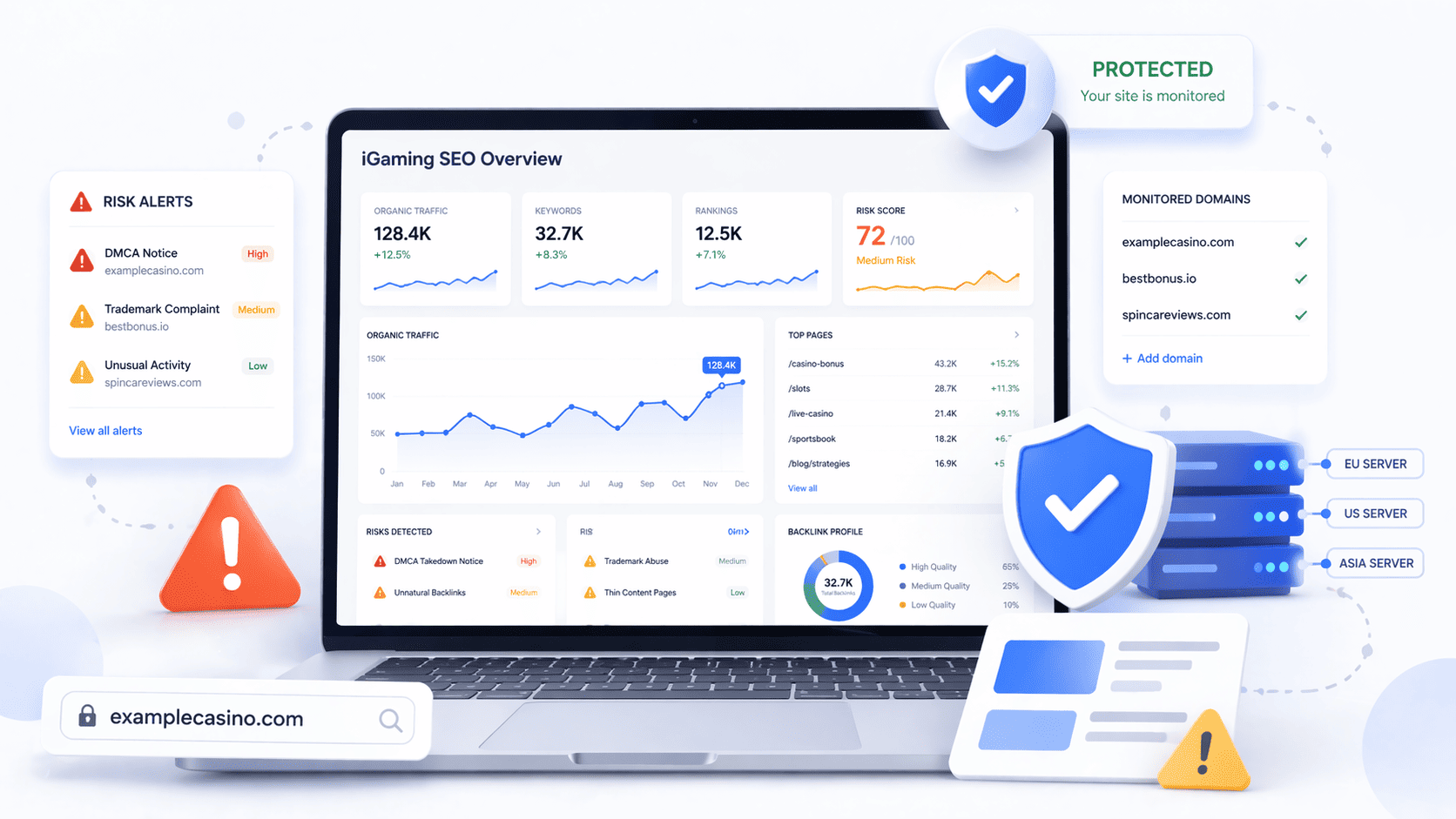
iGaming SEO is one of those high-risk verticals where the upside can be huge, but the pressure is also real. You can build solid organic traffic, scale money sites, push offers in competitive GEOs — and still get hit by abuse reports, hosting issues, domain complaints or local regulator blocks. 🚨
For affiliates, SEO teams and media buyers, this is not some rare edge case. In gambling, betting and casino-related projects, abuses are part of the game. The question is not whether risks exist. The real question is whether your infrastructure is ready when they hit.
If you also run paid traffic alongside SEO, stable infrastructure matters even more — especially when working with Google Ads accounts for different GEOs, account ages and spend history.
🧨 What Are DMCA and TM Abuses?
DMCA abuse is usually a copyright complaint. It can be connected to copied text, images, design elements, landing pages or other protected materials.
TM abuse, or trademark abuse, is more about brand-related elements: logos, names, visual identity, layout details or anything that may look like you are misleading users by copying another brand.
This is especially common for monobrand iGaming sites. Even if the violation is not obvious, competitors can still send complaints just to create pressure. In high-risk niches, abuse reports are not always about law — sometimes they are simply part of the competition. ⚡
📉 What DMCA and TM Abuses Can Lead To
Most copyright or trademark complaints go to the hosting provider. Even if your site is behind Cloudflare, the complaint can still be forwarded to the real hosting provider.
After that, the host may ask you to remove specific elements, take down pages or even delete the entire website. In many cases, you may get only 24–48 hours to react.
And here is the painful part: even if you answer every abuse ticket, it does not guarantee that the host will keep working with you. If the amount of complaints becomes too high, the provider may simply suspend the server because your project looks too risky. 🧯
The result is clear: lost uptime, lost rankings, lost traffic and lost revenue. If you do not have backups, things can get even worse — you may lose the whole project instead of just moving it.
🛡️ How to Handle DMCA and TM Abuses
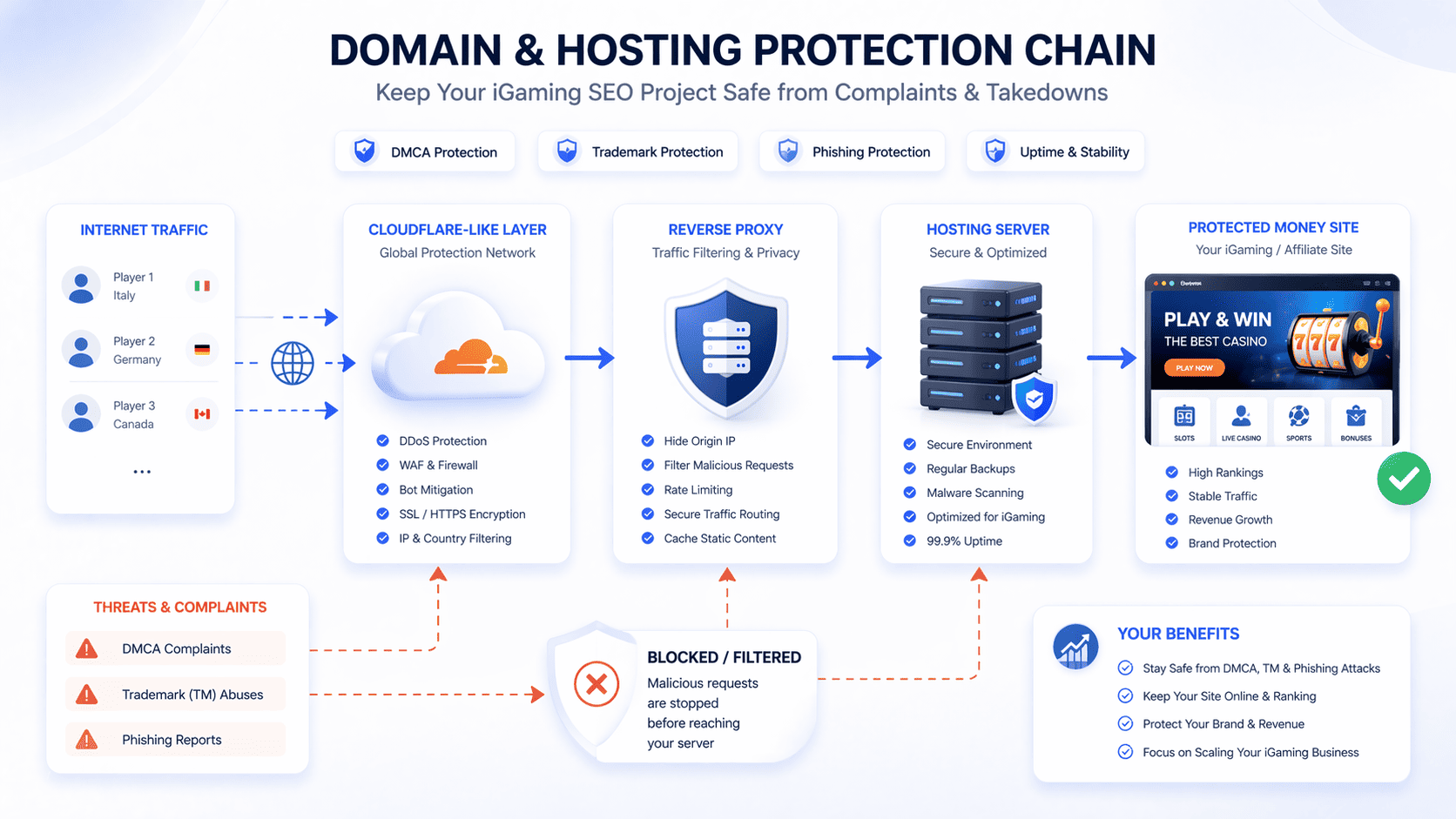
You cannot just ignore abuses when using regular hosting. So the usual strategy is either to work with more abuse-resistant hosting or to build an infrastructure where complaints do not reach the main server directly.
A common setup looks like this:
World → Cloudflare → Hosting
A safer setup for high-risk projects may look like this:
World → Cloudflare → Reverse Proxy → Hosting
The idea is simple: the proxy layer hides the real hosting and reduces the chance that abuse reports hit your main server directly. For iGaming SEO teams, this is not just a tech trick — it is part of survival. ⚙️
🌐 What If Complaints Go to the Domain Registrar?
If the complaint goes not to the hosting provider but to the domain registrar, proxy servers and offshore hosting will not fully solve the issue.
In this case, the domain itself becomes the weak point. That is why choosing the right registrar is important for high-risk SEO projects. Some registrars are stricter, while others are more tolerant toward complaints.
Another important risk is visibility in search. If copyright complaints are indexed in public databases, some pages may lose positions or drop from Google results. If the complaint is false or questionable, you should appeal it. If the domain is already burned, the team may need a new domain, mirror or redirect strategy. 🔄
🧱 How to Protect iGaming Projects From Blocks and Infrastructure Risks
🎣 What Are Phishing Abuses?
Phishing abuse is a complaint claiming that your website steals sensitive user data. This type of abuse is more serious than DMCA or TM complaints.
Phishing complaints are especially common in crypto, but iGaming sites can also get hit. Sometimes the complaint is real. Sometimes it is just negative SEO or dirty competition. Either way, the consequences can be much heavier. 🕵️
🚫 What Phishing Abuses Can Do to Your Site
Phishing reports can trigger not only the hosting provider, but also security systems and blacklist databases.
Your site may get flagged by Google Safe Browsing, VirusTotal or browser-level protection systems. When that happens, users may see warnings that the website is dangerous or deceptive.
For affiliates and SEO teams, this is a direct hit to performance. Even if the site is technically online, traffic quality drops, users bounce, conversions fall and the project starts losing money. 📉
✅ How to Reduce Phishing Abuse Risks
The most obvious solution is to avoid suspicious-looking forms and unnecessary data collection.
If your site does not collect sensitive user information, it is easier to prove that the phishing complaint is fake. Keep pages clean, avoid shady UX patterns and make the project look transparent.
If a phishing complaint comes in, do not ignore it. File an appeal, explain the situation and try to prove that the website is not stealing user data. In some cases, it is better to clarify that the complaint is not about phishing at all, but about copyright or trademark issues.
This same logic applies to paid traffic setups: when scaling campaigns, aged and warmed-up Google Ads accounts can help keep operations more stable, especially when different GEOs and account histories are involved.
🏛️ Local Regulators and GEO-Level Blocks
Every GEO has its own rules for gambling, betting and casino-related content. Some markets are flexible, while others are strict and aggressive.
Local regulators can block domains, block hosting IPs or create access problems from specific regions. Sometimes the website is not officially blocked, but it loads so slowly that users cannot really use it.
For SEO, this is a serious issue. Poor availability means bad UX, weaker behavioral signals, lower conversion rate and less revenue. For media buyers, it can also kill funnels if users cannot open the landing page properly. 🌍
🔥 Domain Blocks, IP Blocks and Slow Access
Domain blocks are usually the most visible. Users from a specific country simply cannot access the site without VPN or proxy.
IP blocks can be even worse. If several projects sit on one IP and that IP gets blocked, the whole cluster can go down at once.
Slow access is more sneaky. The domain may still be alive, the IP may not be officially blocked, but the website loads terribly from the target GEO. For traffic teams, this is almost the same as a soft ban: the site technically works, but performance dies.
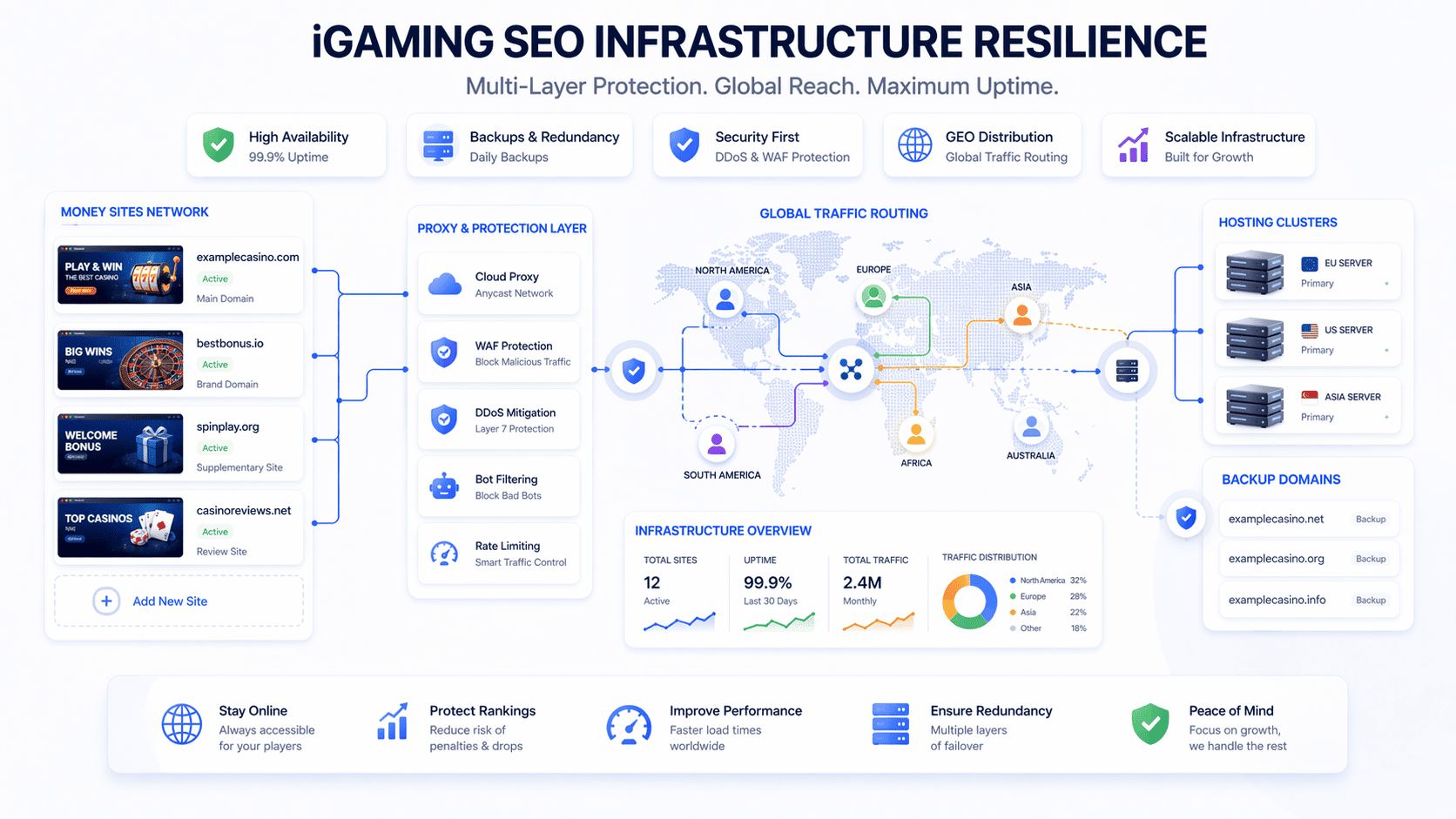
🛠️ How to Build a Safer Infrastructure
You cannot remove all risks in iGaming SEO. This vertical will always attract complaints, blocks and pressure.
The goal is different: make sure one problem does not kill the whole network.
Do not keep all websites on one IP. Do not rely on one hosting provider. Do not depend on one domain. Always have backups, spare domains and a clear migration plan.
If the project targets a specific GEO, infrastructure should be built around that GEO. What works for one country can perform badly in another. Hosting location, IP quality, proxy setup and access speed all matter.
🚀 Final Takeaway
Abuses in iGaming SEO are not an exception. They are part of the vertical.
You may face DMCA complaints, trademark issues, phishing reports, domain blocks, IP blocks and local regulator pressure. But most of the damage can be reduced if your setup is prepared in advance.
The real danger is not the abuse itself. The real danger is having no plan when it happens.
Strong infrastructure, backups, proxy layers, flexible domains and fast reaction processes help keep the project alive. In high-risk SEO, the winners are not the ones who never get hit. The winners are the ones who recover fast and keep the traffic flow running. 💰
For teams combining SEO with paid acquisition, having access to reliable Google Ads accounts — including farmed accounts, accounts with spend history and different account ages — can make scaling more flexible across multiple traffic strategies.