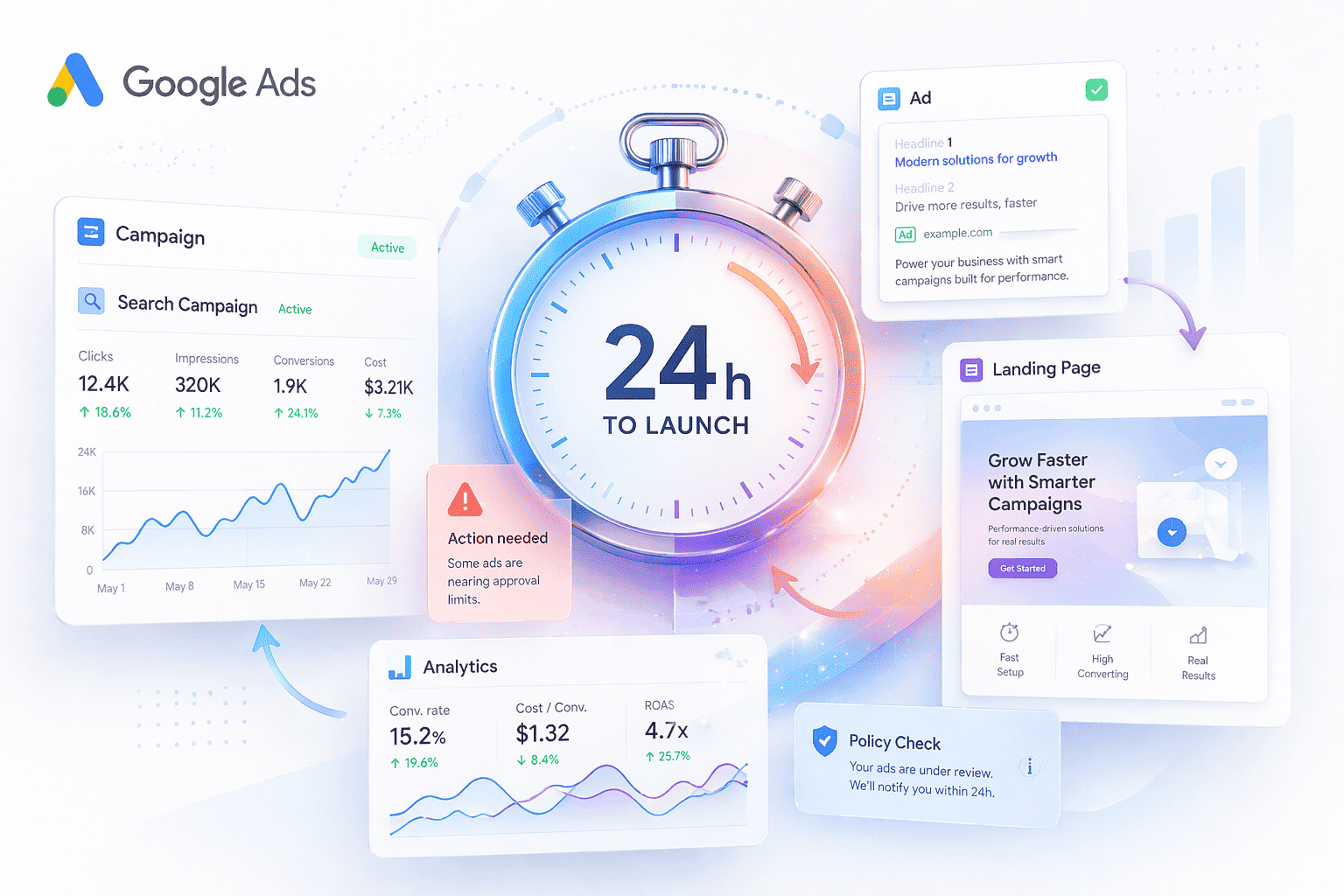
A campaign rarely dies in the first 24 hours because of pure bad luck. More often, it dies because the setup was weak before the first click even came in.
Even strong Google Ads accounts can burn fast when the fundamentals are broken 💸
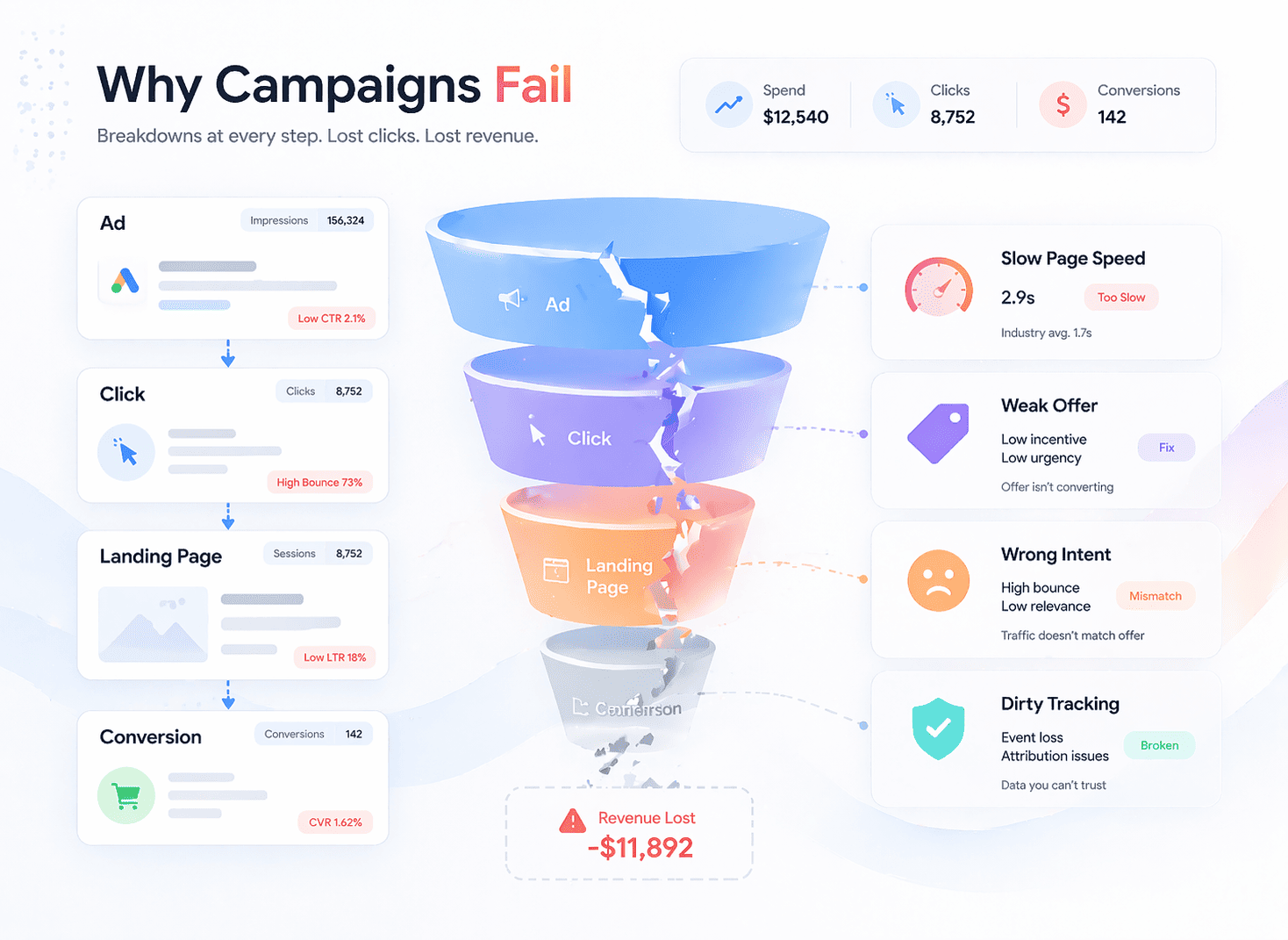
The offer is weak. The ad angle misses intent. The landing page leaks users. The tracking sends dirty signals.
In most cases, the first day does not create the problem — it simply exposes it 👀
If you want cleaner launches, better reads, and fewer false conclusions, you need to diagnose early failure correctly. The first 24 hours usually show whether you have a real traffic opportunity or just a weak setup with spend attached to it.
Top 10 Reasons Campaigns Die in the First 24 Hours ⚠️
1. Weak Offer 💸
If the offer does not feel attractive in the current market, the rest of the setup has almost no room to save it. You may still get impressions and clicks, but real user intent will not convert into action.
A weak offer usually shows up like this:
- soft engagement
- low conversion depth
- weak motivation to act
- fast user drop-off
Main point:
If the market does not want the offer, the campaign starts with a structural disadvantage from day one.
2. Bad Ad Angle 📢
Sometimes the offer itself is fine, but the ad does a poor job of selling it. The hook is weak, the promise is generic, or the positioning is off.
When that happens, the campaign enters the auction with low momentum.
Common signs:
- the ad feels flat
- the message looks too broad
- there is no urgency
- the hook does not create curiosity
Result:
The campaign gets traffic, but not enough attention to build strong early performance.
3. Wrong Search Intent 🎯
This is one of the most expensive mistakes. You may be buying traffic, but not the right traffic.
If the keyword intent, audience intent, or targeting logic does not match the actual conversion path, the campaign may look active while producing almost no real value.
What usually goes wrong:
- the user wants information, not action
- the keyword is too broad
- the traffic is curious, not ready
- the campaign pulls the wrong audience into the funnel
Main point:
A campaign can look alive in the dashboard and still be dead in real business terms.
4. Weak Landing Page 🌐
A campaign often dies because the ad and the page are not aligned. The ad promises one thing, but the landing page delivers something else — or simply does not move the user forward.
This usually creates:
- confusion
- trust loss
- broken momentum
- weak conversion flow
A landing page does not need to be “beautiful.”
It needs to be clear, relevant, and conversion-friendly.
If the handoff from ad to page is weak, the campaign starts leaking immediately.
5. Slow Page Speed ⏳
Page speed is still one of the easiest ways to lose money silently. If the user clicks and waits too long, they bounce before your pitch even starts.
In the first 24 hours, this can distort performance so badly that a decent offer looks dead.
Typical first-day damage:
- higher bounce rate
- weaker engagement
- lower conversion rate
- misleading performance read
Main point:
Sometimes the campaign is not weak — the page is just too slow to let it work.
6. Dirty Tracking 📉
Bad tracking destroys decision-making. Duplicated conversions, delayed events, broken attribution, or noisy signals can make a bad campaign look fine — or a decent campaign look worse than it really is.
This is dangerous because the buyer starts optimizing against fake reality.
What dirty tracking creates:
- wrong conclusions
- false winners
- fake losers
- distorted scaling decisions
If the signal is dirty, the optimization logic becomes weak from the start.
7. Tough Auction ⚔️
Sometimes the market is simply expensive. If the auction is aggressive and the campaign enters it without strong CTR, clear relevance, or enough signal quality, budget disappears fast.
This gets especially brutal when:
- the setup is still raw
- the ad is not strong enough
- the targeting is too loose
- the campaign has no early edge
Main point:
A tough auction punishes weak launches very quickly.
8. Low CTR 👀
Low CTR is not just a metric. It is an early warning sign.
It often means:
- the ad is not pulling attention
- the angle is not competitive
- the message feels weak
- the targeting is too broad
Once that happens, the platform gets a weak early read and the campaign starts losing momentum fast.
Low CTR often means the market is not buying your first impression.
9. Junk Traffic 🗑️
Not all traffic is useful. Some campaigns die because the clicks are cheap but empty, or because the targeting structure brings low-value users into the funnel.
That creates one of the worst possible first-day situations:
- spend goes out
- low-quality users come in
- learning stays weak
- optimization becomes noisy
Cheap traffic is not always good traffic.
Sometimes it is just cheap waste.
10. Killing It Too Early 🔪
This one comes from the buyer, not the platform.
Sometimes a campaign is paused before the data has enough time to take shape. Yes, weak campaigns should be cut fast. But some setups need enough volume to show whether the issue is structural or just temporary noise.
A simple diagnostic rule helps here:
- cut fast when the setup is clearly broken
- wait a bit when the signals still look clean
- never make a hard decision from panic alone
Main point:
Some campaigns die because they were weak.
Others die because the buyer never gave them enough room to reveal the truth.
How to Diagnose the First 24 Hours Without Guessing 🧠
Check the Chain First: Offer → Ad → Intent → Landing 🔗
Before changing bids, budgets, or campaign settings, check whether the core conversion chain actually makes sense.
In many failed launches, the problem sits in one of these handoffs:
- offer → not strong enough for the market
- ad → not selling the offer properly
- intent → traffic does not match the real buyer journey
- landing → page does not continue the message
A simple diagnostic checklist helps:
- Does the offer fit the market?
- Does the ad sell the offer clearly?
- Does the targeting match the user’s real intent?
- Does the landing page continue the same message?
If that chain is weak, no amount of tactical tweaking will rescue the campaign.
Verify Signal Quality Before Scaling or Cutting 📡
Many buyers react too early to first-day numbers without checking whether those numbers are even trustworthy.
Before making a hard decision, verify:
- whether conversions are tracked correctly
- whether there are delayed events
- whether there are duplicated events
- whether click quality makes sense
- whether the traffic source matches the expected audience
Why this matters:
- broken signals create fake winners
- delayed signals create false panic
- duplicated events distort the real picture
If the data is wrong, the diagnosis will also be wrong.
Separate a Weak Setup from a Weak Market 🌍
A failed first day does not always mean the market is dead.
Sometimes:
- the GEO is still viable, but the angle is wrong
- the targeting is fine, but the landing page is leaking
- the offer is decent, but the ad is too soft
- the campaign has potential, but the setup entered the market weak
This is why experienced buyers do not say:
“The campaign failed.”
They ask:
“What failed first?” 👀
That question leads to real fixes.
Know When to Pause and When to Let It Breathe ⏱️
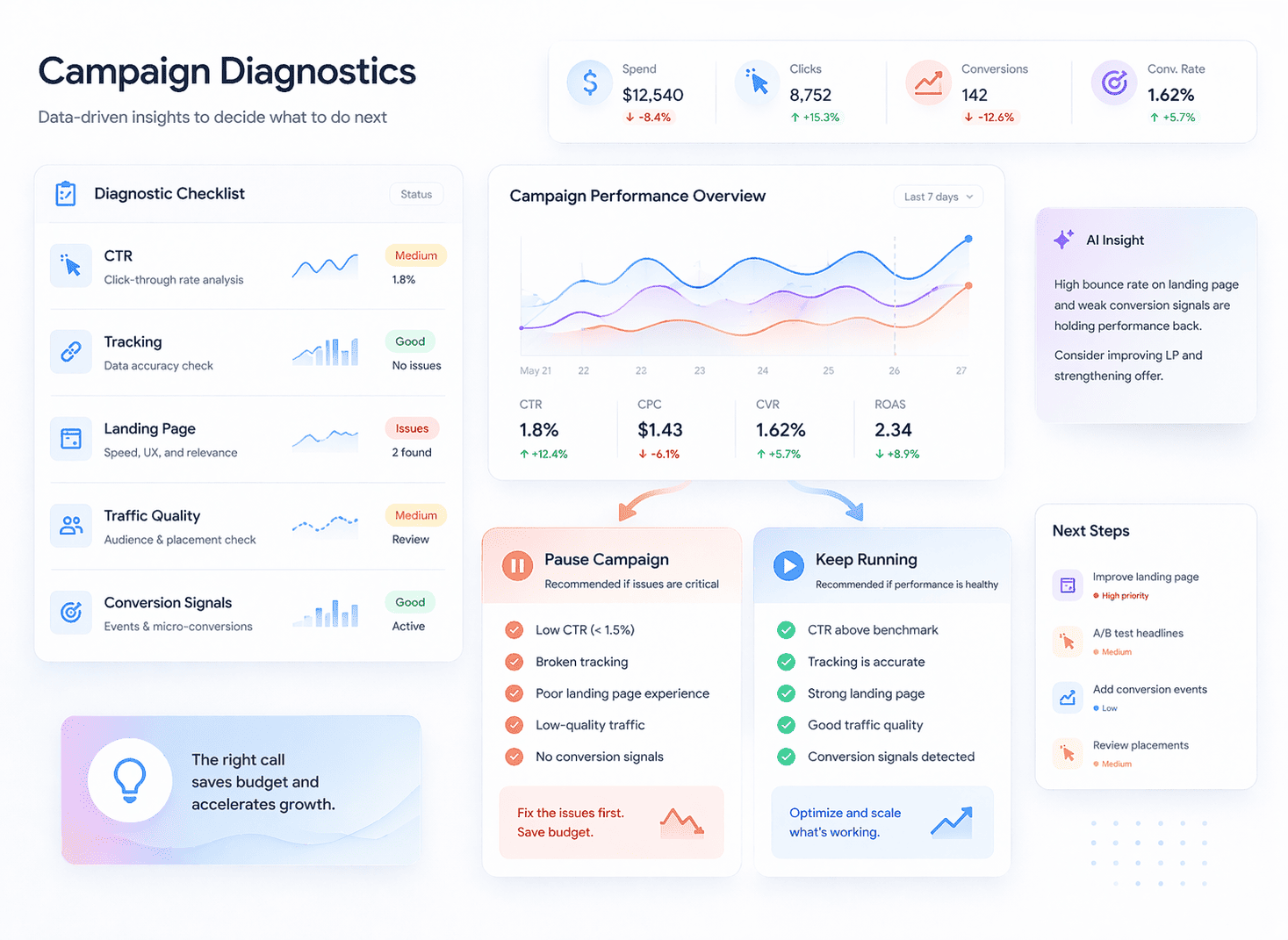
Pause Fast When 🚫
- CTR is extremely weak
- there is an obvious mismatch between the ad and the landing page
- tracking is broken
- traffic quality looks very poor
- spend is coming in but there is no useful signal
Give It More Time When ✅
- click quality looks good
- CTR is healthy enough
- the landing page is aligned with the ad
- tracking is clean
- the campaign simply needs more volume to show conversion shape
Best practice:
Do not react emotionally.
React based on signal quality, traffic quality, and structural logic.
Final Takeaway 🚀
The best first-day operators are not emotional. They do not panic, and they do not fall in love with a launch. They read the first 24 hours like a diagnostic layer.
When a campaign dies in the first 24 hours, the problem is usually not bad luck or “Google being weird.” It is usually one of the fundamentals:
- the offer
- the ad angle
- the intent
- the landing page
- the speed
- the signal quality
That is why the smartest rule is still the simplest one:
Fix the fundamentals first. Optimize second. Scale last. 🔥