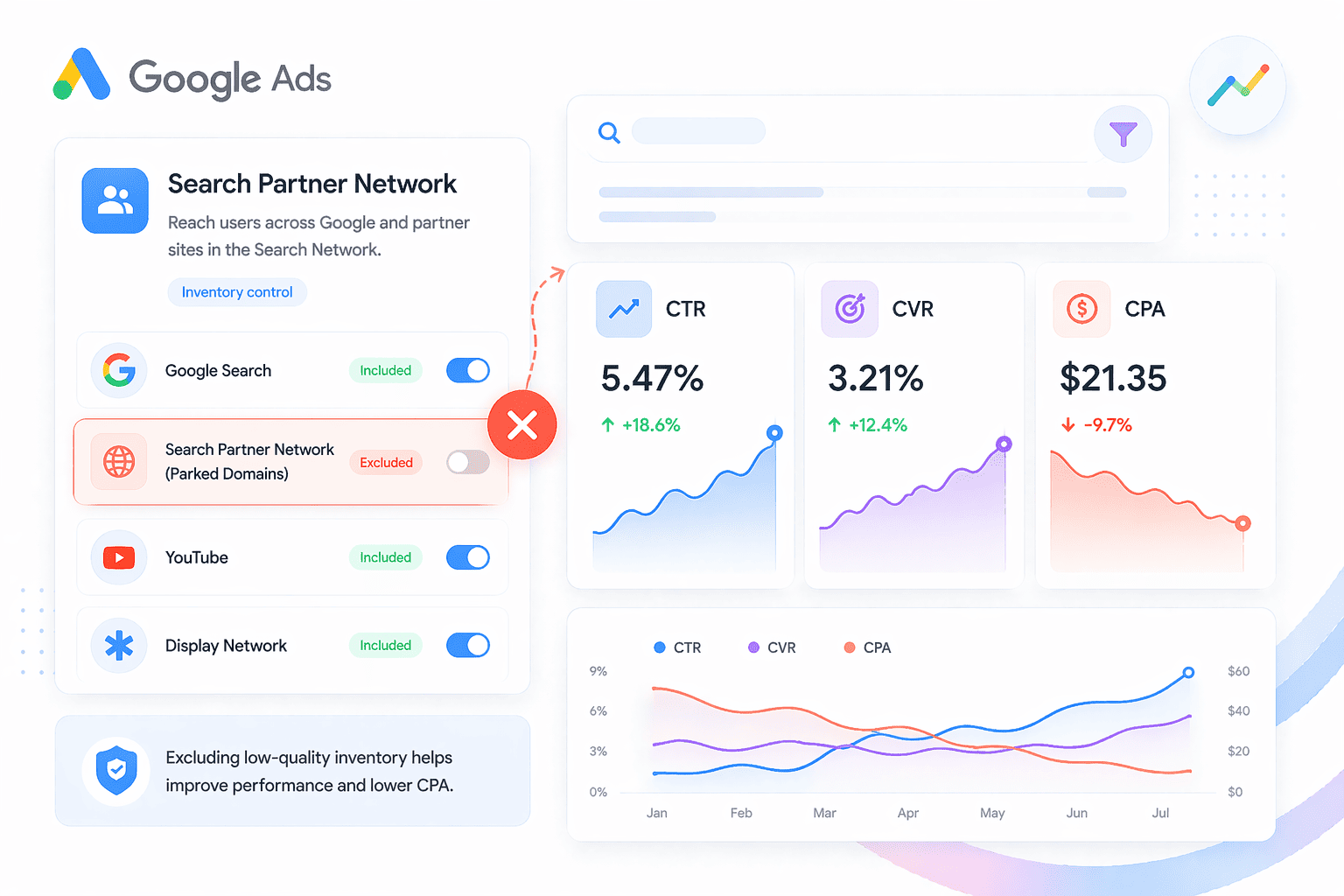
Google has removed parked domains from the Search Partner Network 🚫🌐. At the same time, the option to include them in Content suitability has been removed as well. For advertisers running campaigns with Search Partners enabled across multiple Google Ads accounts, this may look like a small update on paper — but it can still have practical implications.
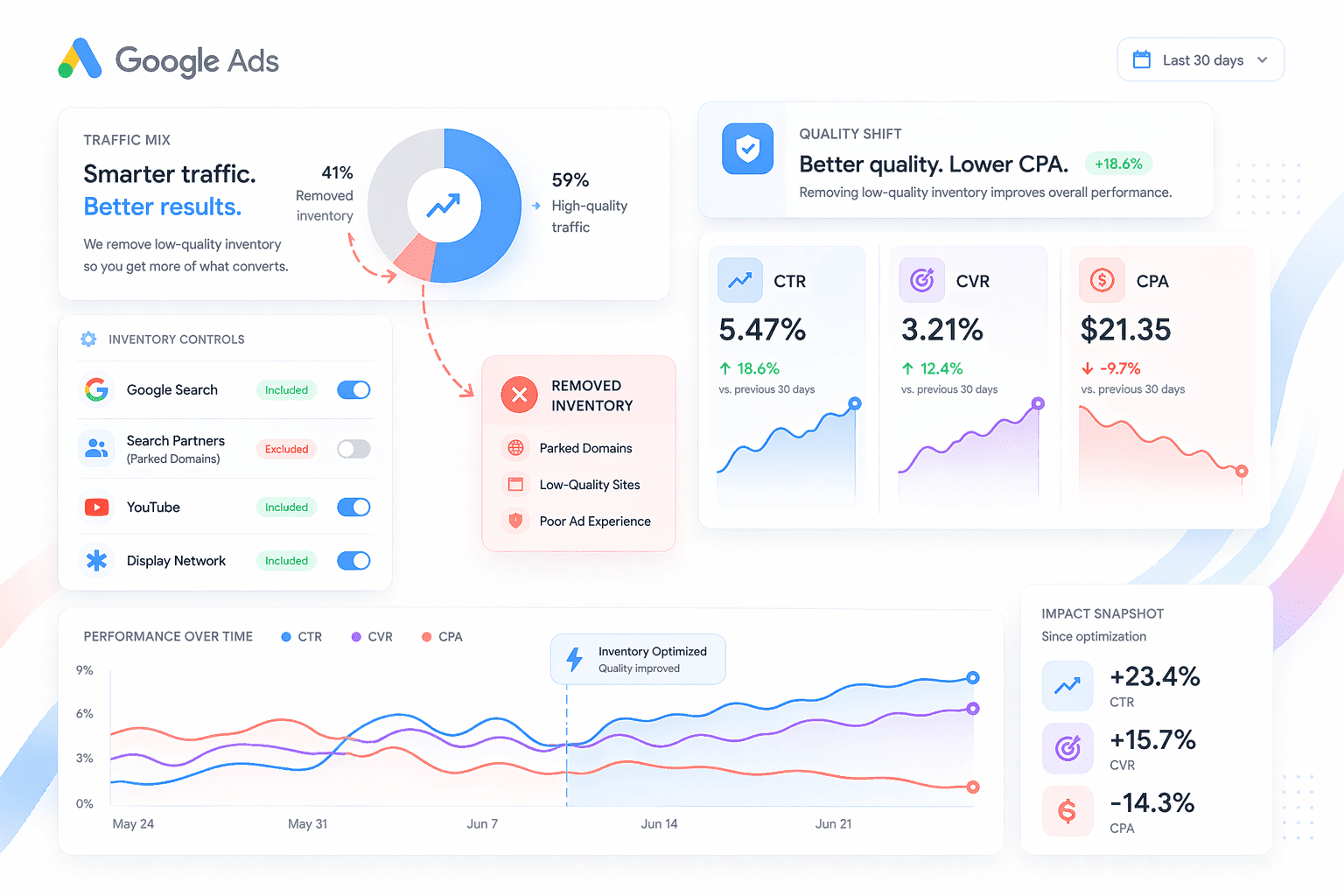
This does not automatically mean that performance will improve overnight. But it does mean the traffic mix inside Search Partners may shift, which can affect how campaigns behave across clicks, conversion quality, and efficiency signals 📊👀.
That makes this change worth watching, especially for teams working with aged Google Ads accounts, scaling partner traffic, or comparing quality across multiple campaign setups.
Your content goes here. Edit or remove this text inline or in the module Content settings. You can also style every aspect of this content in the module Design settings and even apply custom CSS to this text in the module Advanced settings.
What Actually Changed in Search Partners ⚙️
Parked domains are no longer part of the ad surface
Google’s official announcement is simple: parked domains are no longer an ad surface in the Search Partner Network. The related setting in Content suitability was also removed, and the change was applied automatically.
Why this matters in practice
For media buyers, the key point is not the wording of the update — it is the possible effect on partner traffic composition. If one inventory type disappears, then the overall behavior of Search Partners traffic can shift as well. That may show up in a few ways:
- different click patterns 👀
- slightly different CTR behavior 📈
- changes in conversion quality 🎯
- changes in CPA or CVR distribution across campaigns 📉
These outcomes are not guaranteed, but they are reasonable areas to watch after the inventory change.
What Advertisers Should Recheck Now 🧠
1. Partner traffic performance
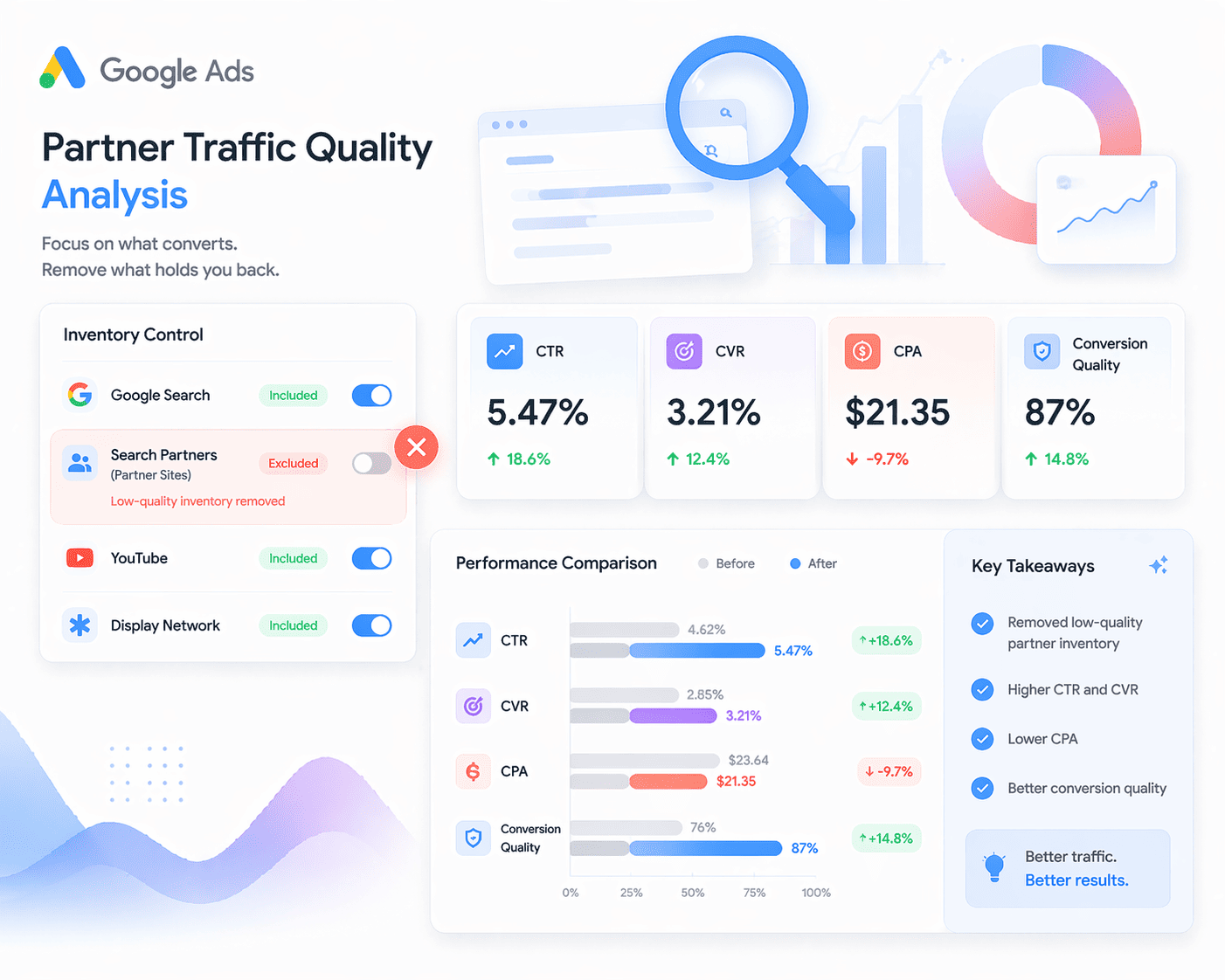
If Search Partners are enabled in your campaigns, compare recent performance against your earlier baseline. Focus on where partner traffic was already meaningful, not just where it was technically present.
A practical review usually starts with:
- CTR
- CVR
- CPA
- conversion quality
- traffic consistency
2. Campaign-level behavior
Not every campaign will react in the same way. Some may show almost no visible change, while others may shift more noticeably if partner traffic had a stronger role in the mix.
That is why it makes sense to recheck:
- campaigns with strong Search Partners exposure
- campaigns with unstable quality patterns
- campaigns where partner traffic historically behaved differently from core search traffic
The Practical Takeaway for Buyers 🚀
This is not the kind of platform update that guarantees dramatic results by itself. But it is exactly the kind of infrastructure change that can quietly affect campaign behavior over time.
If Search Partners are part of your setup, this is a good moment to:
- recheck recent performance 📡
- compare quality patterns before and after the change 📊
- review CTR / CVR / CPA more closely 👀
- pay extra attention to partner traffic behavior ⚙️
Final Takeaway 🔥
Small update. Real operational meaning.
Google removed parked domains from the Search Partner Network, so advertisers using Search Partners should take a fresh look at how partner traffic behaves now. The smartest move is not to assume better or worse performance in advance — it is to recheck the data and let the numbers show whether quality patterns have changed.